
The tools on your desk
More room for the story in your head.
Plan its shape. Write its scenes. Follow every change. One connected workbench, from the seed to the final export.
01 / Seed
Seed
The Snowflake Method as a living tree: one-sentence seed → five parts (setup, three disasters, ending) → synopses → character charts → scenes. Guided steps with progress.
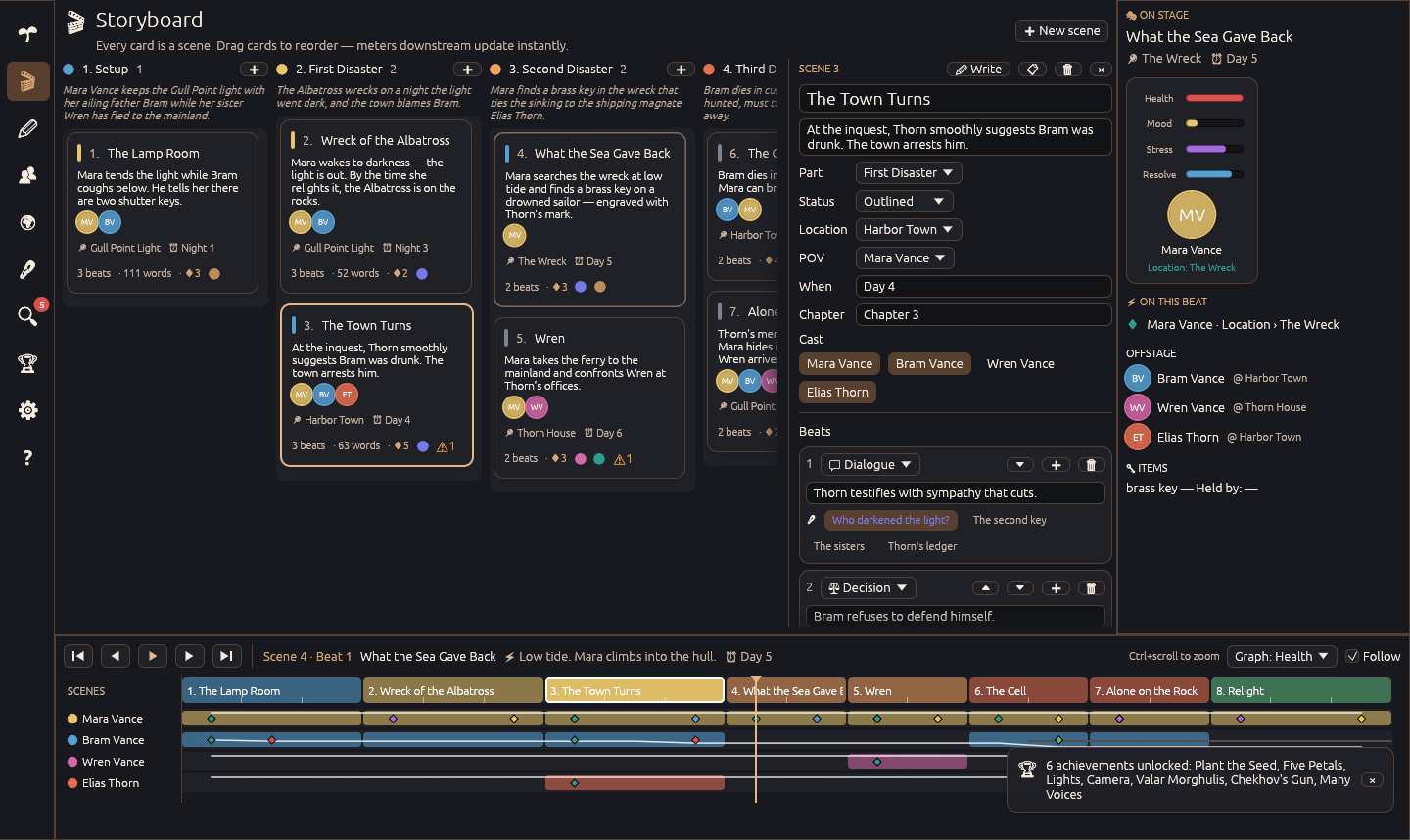
02 / Storyboard
Storyboard
Scene cards in five part-columns. Drag to reorder; the timeline and all downstream state update instantly. Inspector for beats, cast, POV, location, time, threads and state changes.
03 / Timeline
Timeline
Video-editor-style sequencer: scene blocks, beat ticks, a track per character showing presence, death, state-change markers and a meter graph. Play, step, scrub, zoom.
04 / Stage
Stage
Who's in the scene at the playhead, with animated sim meters over their avatars, what changes on this beat, who's offstage and where, and who holds which item.
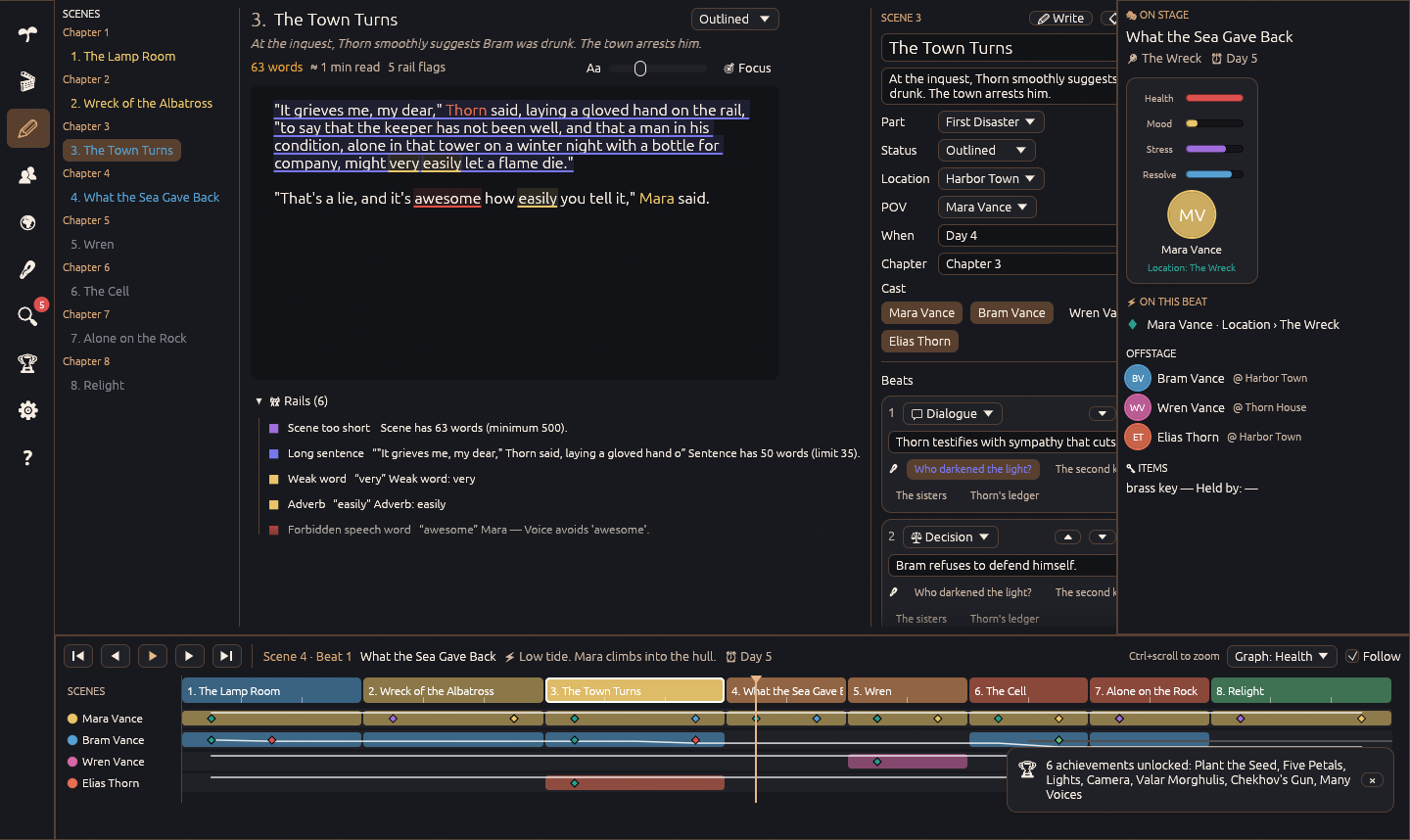
05 / Write
Write
Distraction-free editor (focus mode) with live rails: long sentences, adverbs, passive voice, filter/weak words, repetition, clichés, fancy dialogue tags, banned words, scene length, and per-character voice rules, all underlined inline. Character names are tinted in their colors.
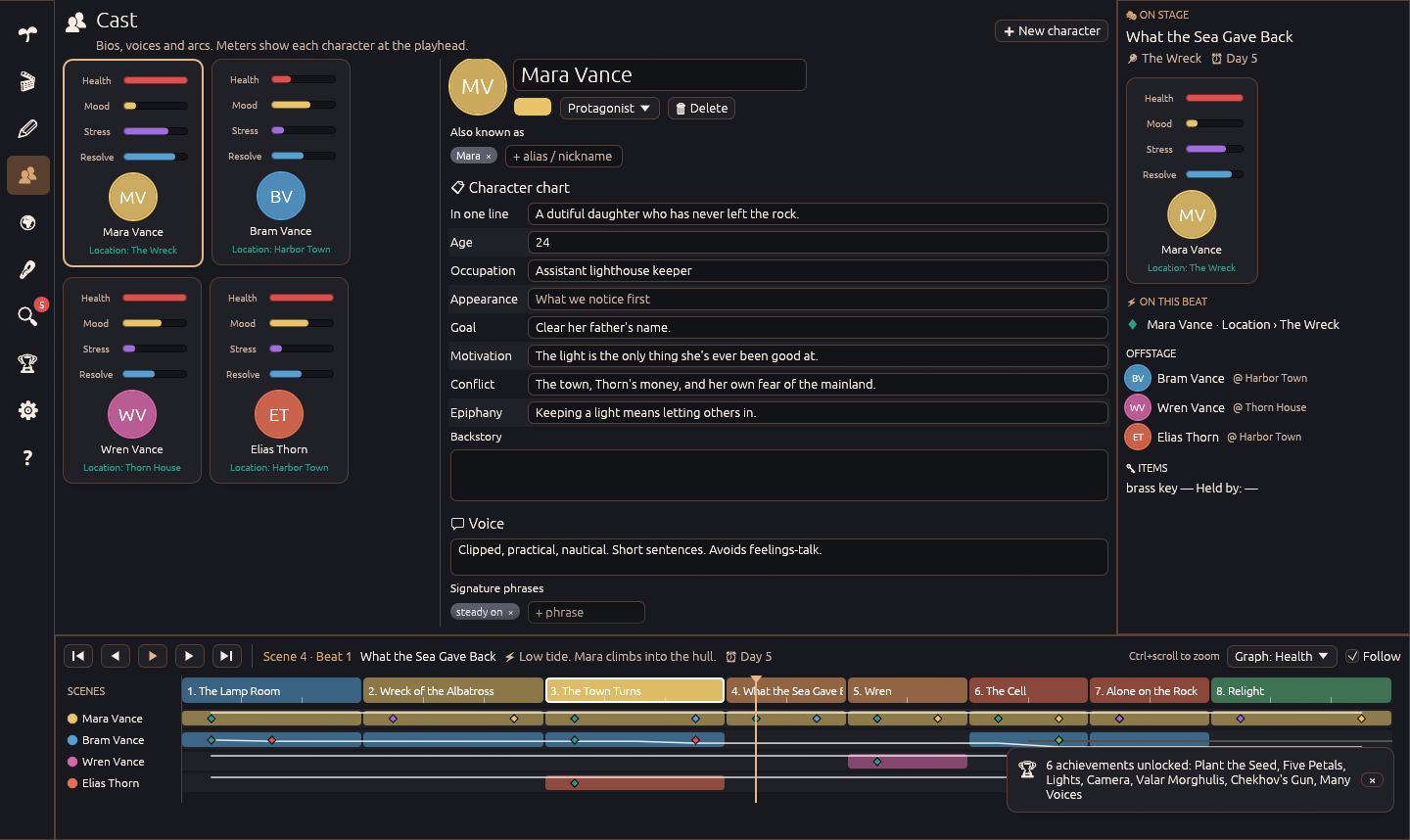
06 / Cast & World
Cast & World
Character charts (goal, motivation, conflict, epiphany…), speech styles (signature phrases, words they never say, sentence length, contractions), starting state, an arc graph of every meter across the story, appearances. Locations, items and factions.
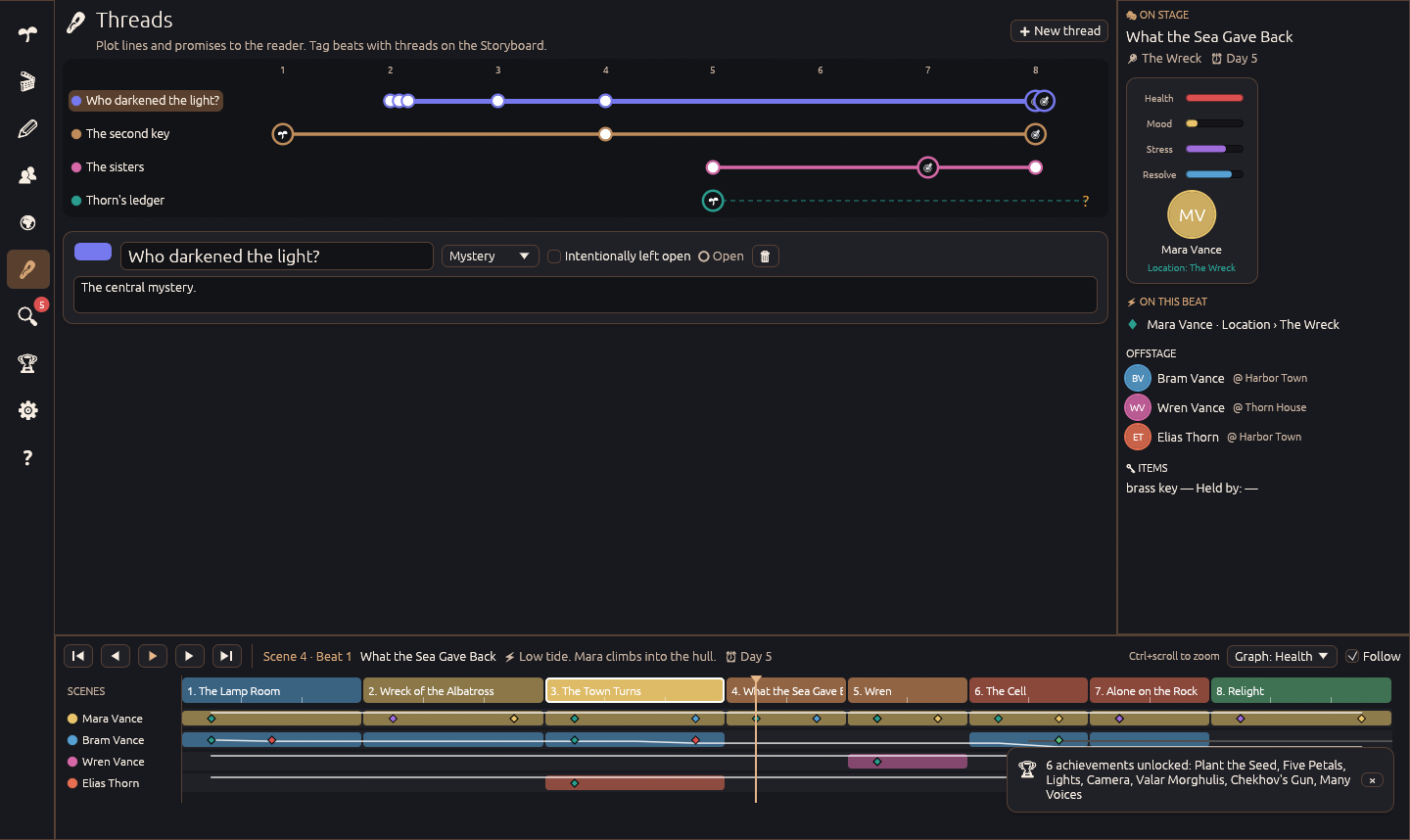
07 / Threads
Threads
Plot threads as a subway map. Tag beats as Setup → Payoff; unpaid setups (Chekhov's gun), early payoffs and dormant threads are flagged.
08 / Checks
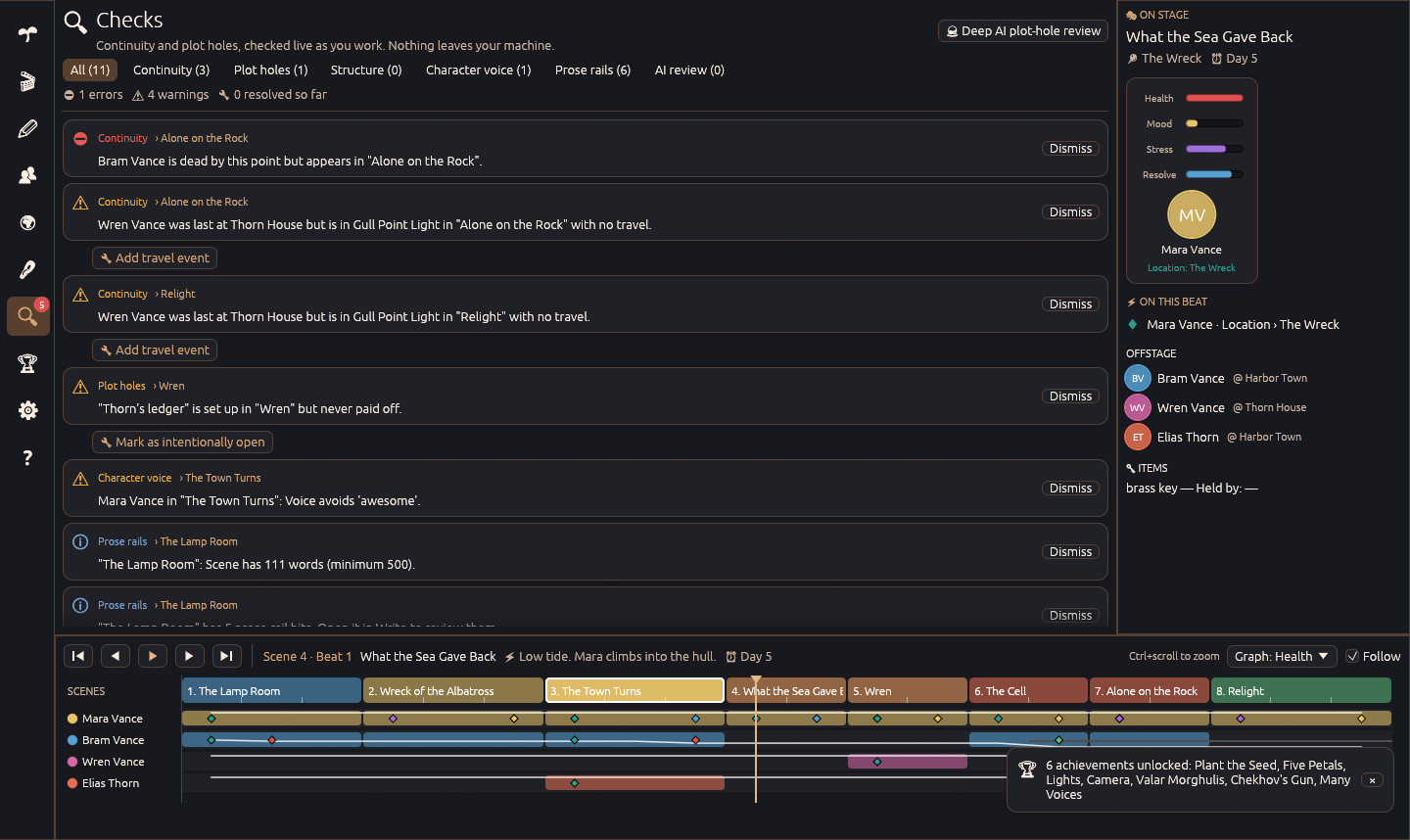
Checks
Dead characters walking, characters teleporting between locations, items used by someone who doesn't hold them, characters speaking in scenes they're not in, cast/mention mismatches, unmotivated leads, structure gaps, voice drift. One-click fixes; dismiss what's intentional.
09 / BYO AI
BYO AI
Claude Code or Codex desktop CLIs (uses your existing login, no keys stored), Ollama / LM Studio (fully offline), Anthropic, OpenAI, Venice AI, OpenRouter or any OpenAI-compatible endpoint. AI proposes and you accept: plot-hole review, state-change detection, seed expansion, scene suggestions, beat breakdowns, character bios, voice checks and scene feedback.
Set up your provider →10 / Achievements
Achievements
23 writing achievements, synced to Steam on Steam builds.
Read all the achievements →11 / Help
Help
Built-in searchable manual opening with a self-checking quick start tutorial. Every mention of a feature links to it; F1 opens help for the current page.
12 / Import / Export
Import / Export
Import Markdown, plain text or Fountain (splits into scenes; scripts auto-create characters and locations). Export Markdown, Fountain, plain text, HTML manuscript, or a full outline.